
Six Costing Mistakes That Sink a Refillable Perfume Brief
Refillable cost surprises are usually blamed on the factory, but most of them were created in the brief. A short brief leaves the supplier to choose the interface, the fill tolerance and the pack-out, and those three choices decide more of the unit cost than the juice does. The six mistakes below are the ones that recur, and each has a correction that costs nothing except a second look at the document you send.
Key takeaways
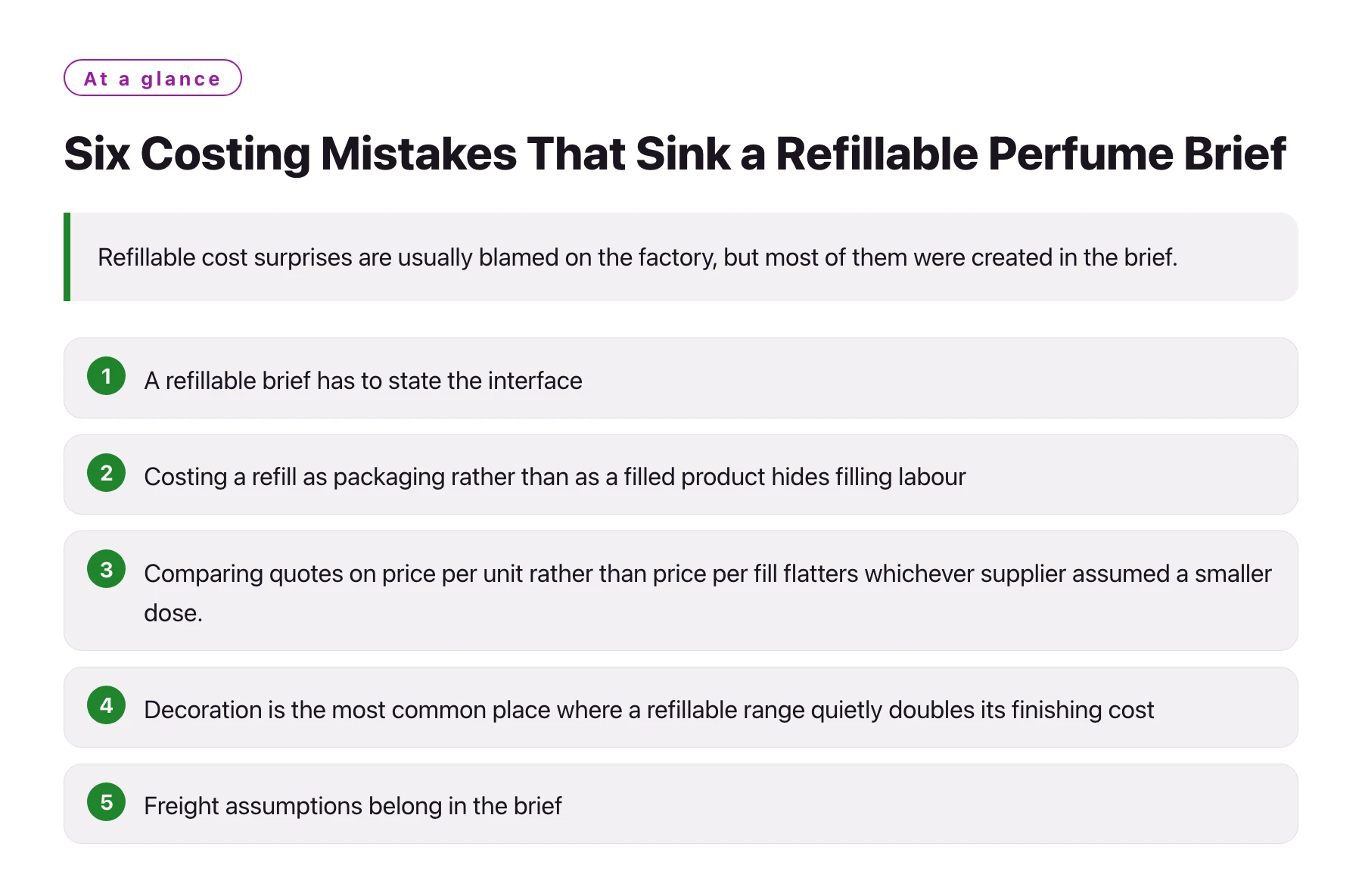
- A refillable brief has to state the interface, the number of fills the pack is expected to survive and the fill tolerance, or the supplier will choose all three on the brand's behalf.
- Costing a refill as packaging rather than as a filled product hides filling labour, label control and compliance work, which then reappear as a change order.
- Comparing quotes on price per unit rather than price per fill flatters whichever supplier assumed a smaller dose.
- Decoration is the most common place where a refillable range quietly doubles its finishing cost, because both the vessel and the refill are treated as shelf-facing.
- Freight assumptions belong in the brief, since a refill configured for a set behaves very differently from one shipped as a stand-alone retail unit.
The buyer's instinct is to write a brief that describes a scent and a look, then ask for a price. With a refillable format that instinct fails earlier than usual, because the cost of the system is decided by mechanical choices that a scent-and-look brief never mentions.
It is worth understanding how the supplier reads the document. Where the brief is silent, the factory applies its standard assumption, and a standard assumption is almost always the cheapest answer to the question it was asked. That is how a brand ends up with a refill that works, costs more than expected, and cannot easily be changed once tooling exists.
These six mistakes are not exotic. They are the ordinary gaps that show up when a first refillable quote is compared with the second one.
Where a refillable brief goes wrong first
A refillable project has an extra specification layer compared with a sealed bottle. The brand is not only buying a fragrance and a pack; it is buying a mechanical promise that the system will still hold together after repeated use. If that promise is not written down, it cannot be priced.
The correction is unglamorous. Add four lines to the brief: the interface, the number of refill cycles to be validated, the declared fill volume and its tolerance, and the retail configuration. Everything else in the cost discussion becomes easier once those exist.
Mistake one: leaving the interface to the supplier
The interface choice drives filling equipment, torque, seal material and the leak test. Delegating it is not automatically wrong, but delegating it without asking which option was selected means the tooling bill arrives before the brand has agreed to the mechanism.
Ask for the interface options with a cost and a risk note attached to each, rather than a single recommendation. Comparing published scopes helps as well: Xuelei China sets out the services it covers, so the boundary of a quote is visible before the brief is written.
Mistake two: treating the refill as packaging
A refill that contains fragrance is a filled product. It needs its own fill record, its own label control and its own place in the quality plan. In the European Union, cosmetic products also require a Responsible Person and a product information file before they are placed on the market [1].
If the refill is priced as an empty component, those obligations have nowhere to sit in the quote, and they surface later as an addition.
The six mistakes, and what the quote looks like afterwards
| Mistake | How it appears in the quote | Correction |
|---|---|---|
| Interface left unspecified | One mechanism quoted, no alternatives, tooling as a lump sum | Ask for two options with cost and validation notes |
| Refill priced as packaging | Filling labour and label control missing from the line items | State that the refill is a filled, labelled product |
| No fill tolerance stated | Broad tolerance assumed, yield looks optimistic | Write the declared volume and tolerance into the brief |
| Dose not expressed per fill | Price per unit compared, not price per fill | Convert every quote to cost per delivered fill |
| Decoration assumed on both parts | Finishing cost roughly doubles against the estimate | Decide which component faces the shelf |
| Freight configuration unstated | Set-based packing assumed for a stand-alone refill | Name the retail format and the shipping unit |
Every correction in the third column is a sentence, not a redesign. The expense is in the delay, not the wording.
The two mistakes that cost the most money
Two of the six deserve more attention because their effect compounds. The first is comparing quotes without a common dose; the second is buying finishing that the customer will never see.
Comparing unit price instead of cost per fill
Two suppliers can quote the same refill at the same price and deliver different amounts of fragrance. Unless the quote states the dosage and the fill volume, the comparison is not a comparison at all. This is the same problem that makes reading a perfume price breakdown worth the effort, because the line that was omitted is often the line that decides the outcome.
Restricted materials add a second dimension. Where a formula leans on materials with IFRA Standards limits, reformulating later can change both the cost and the label [2].
Buying decoration nobody sees
A refill lives inside the vessel for most of its working life. Decorating it to the same standard as the primary pack rarely changes a purchase decision, yet it is one of the easiest costs to add and one of the hardest to remove.
The wider packaging conversation is moving in the same direction. Design guidance from packaging bodies treats refill and concentrated formats as a way to reduce material use, which is a poor fit with two fully finished components inside one another [3].
Where a brand does want a retail-ready refill, it is usually cheaper to run that as private label fragrance production with its own simple pack than to over-finish the in-set refill.
A short review before the brief is sent: does the document name the interface, the cycle count, the fill tolerance and the retail configuration? If any of the four is missing, the supplier will fill the gap with the cheapest assumption, and the brand will pay for it at tooling.
Sources
- European Commission: Cosmetics in the EU —— The European Commission's overview of EU cosmetics rules, including the responsible person, product information file and safety report requirements.
- IFRA Standards Library (International Fragrance Association) —— The IFRA Standards Library lists the restrictions the fragrance industry applies to individual fragrance ingredients, based on safety assessments; it is the reference point for compliant fragrance formulation.
- Sustainable Packaging Coalition —— A membership organisation working on more sustainable packaging design, publishing material and recyclability guidance.
Frequently asked questions
How many refill cycles should a brief specify?
Enough to cover realistic use for the product's life, and enough to give the leak test something to prove. The number matters less than writing one down, because it determines the seal material, the thread geometry and the test standard the supplier will apply.
Is it cheaper to buy the vessel and the refill from different suppliers?
Sometimes, but it shifts the risk of fit and leakage onto the brand. When two suppliers each meet their own drawing and the system still leaks, the cost of resolving it belongs to whoever assembled the specification, which is the brand.
Why do two suppliers quote such different prices for the same refill?
Usually because they assumed different things. One may have excluded filling labour, label control or the leak test, or assumed a wider fill tolerance that reduces rejects. Comparing the assumptions line by line explains most of the gap.
Does a refillable format reduce packaging cost overall?
It reduces material use over the life of the product, because one vessel serves many fills. It does not reduce the first order, which carries tooling and a more demanding quality plan. Brands that expect an immediate saving on the first order are usually disappointed.
Who should write the fill tolerance, the brand or the factory?
It should be agreed rather than written by one side. The factory knows what its line can hold repeatedly; the brand knows what the label can claim. A tolerance that only one of them has accepted is a future dispute, not a specification.
Cut your next access-review cycle by 71%.
Book a 30-minute tailored demo with an access governance specialist. Walk through your reviewers, your apps, and your audit clock.