
Wholesale Jewelry OEM Services Explained
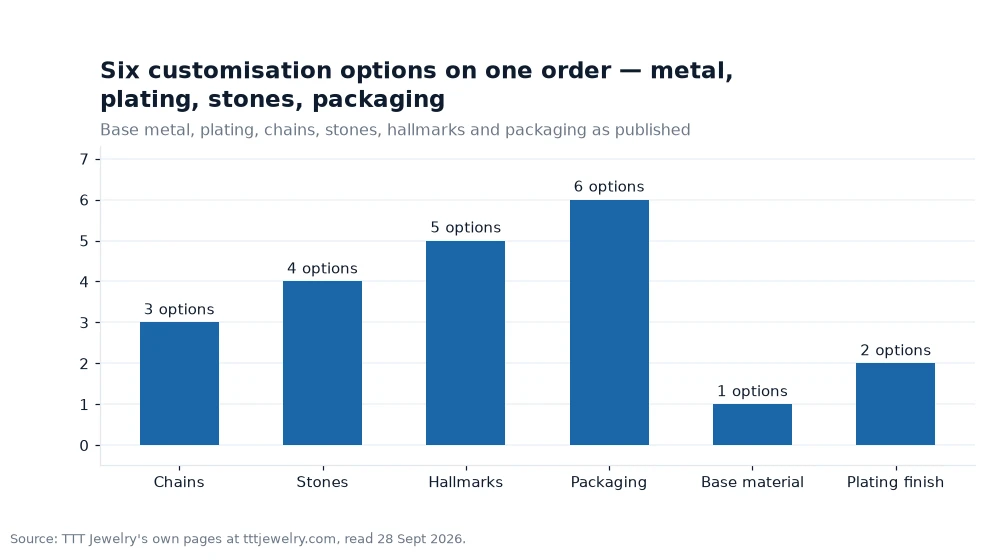
A wholesale OEM jewelry service is a menu of decisions, not a catalogue of stock. TTT Jewelry publishes six customisation blocks — base metal, plating and finish, chains and findings, stones, hallmarks and packaging — and each one adds an input the buyer must supply before the CAD file is released. Order minimums follow the metal: 50 pieces per design in 925 sterling silver, 100 in artisan eco-brass and 100+ in stainless steel.

Key takeaways
- Six customisation blocks are published, and every one of them adds a buyer input before CAD release.
- A silver run starts at 50 pieces per design, half the 100-piece brass minimum.
- 3D CAD is quoted under 48 hours, sampling at 25–30 days and bulk at 21–28 days, a 48–60 day chain in total.
- Final QC inspects 100% of pieces, so a 250-piece order means 250 inspections rather than a sample.
What the six blocks actually change
Treat the list as a set of production routes rather than optional extras. Plating shows why. Multi-layer 14K, 18K or 24K gold and rhodium are applied to silver and brass by electroplating, with an anti-tarnish e-coating on top; stainless steel goes through PVD vacuum plating instead, because a vapour-deposited layer bonds to that alloy differently from a wet bath. Choosing stainless does not only change the metal; it changes the finishing line the order travels through.
The other five blocks behave the same way. Chains and findings decide whether a pendant ships as a finished necklace or as a component the buyer assembles later. Stones and accents — natural stone, freshwater pearl, CZ — arrive with their own size tolerances, so a setting plan is fixed at CAD stage rather than after casting. Hallmarks are a marking decision: laser engraving of S925, 316L or 18KGP tells a consumer what the piece is and, in some markets, what it legally has to be. Packaging is the only block on a separate calendar, since foil-stamped boxes, metallic logo tags, velvet pouches, backing cards and barcode labels are printed and assembled away from the bench.
The input each block demands
A service list becomes useful when it is read as an obligation on both sides; the full set of blocks, with order terms, is listed at www.tttjewelry.com/custom-jewelry-wholesale/. The table sets out what each block asks of the buyer, and what it consumes once the answer arrives.
| Block | Buyer must supply | Consumes |
|---|---|---|
| Base metal | Target alloy and quantity per design | Tooling and a minimum-order slot |
| Plating and finish | Colour reference and wear context | A plating load and a colour check |
| Chains and findings | Clasp type, length and link style | Bench assembly time |
| Stones and accents | Stone type, size and grade band | Setting time inside sampling |
| Logos and hallmarks | Vector artwork and mark placement | A laser cell pass |
| Packaging | Dieline, copy and barcode data | A print lead time outside the bench |
Read the third column as a queue rather than a cost. A finish reference that arrives after casting means the plated sample cannot be judged against the buyer's target, and the piece goes back to polishing for a correction that would have taken one line of text at brief stage.
Two blocks carry compliance weight rather than aesthetic weight. REACH restricts lead, cadmium and nickel, and the plating has to be compliant with REACH and CA Prop 65 before a finish can be offered into the EU or California. Hallmarks and barcode labels are the other pair: both are struck or printed onto the finished piece or its packaging, and both are awkward to correct once the run has started.
Where the factory's scope stops
Wholesale here means volume terms, not ready-made inventory. The published model splits in two: OEM is you design, we produce, with the buyer's CAD or reference driving the tooling and the intellectual property staying with the buyer; ODM is you inspire, we create, where the factory develops a concept into a finished collection that remains exclusive to the brand. An OEM/ODM jewelry manufacturer working either way keeps 100% NDA cover over the design, and the moulds, CAD and collection are not resold or shown to other clients.
That boundary matters when a buyer asks for a catalogue item with a colour change. A piece that already exists in a factory archive is not open wholesale stock; it belongs to whichever brand commissioned it. Genuine custom jewelry wholesale work therefore starts from the buyer's own drawing or from a fresh ODM concept, never from re-badging another client's piece.
Order quantities and what they imply
Minimums are quoted per design, which is a different measure from total order size. Three designs in silver means 3 × 50 = 150 pieces; the same three in brass means 3 × 100 = 300. A buyer spreading a fixed budget across a wide range should count designs first and pieces second.
The same arithmetic explains why the stainless figure is written as 100+ rather than a round number: the plus marks a floor that moves with the geometry of the piece, and a heavyweight cast cuff is not the same order as a 2 mm cable chain. MOQ also interacts with packaging. Gift boxes usually sit outside the jewelry minimum, but a foil-stamped box with a barcode label still needs artwork approval, and that approval has to land before the bulk packing date rather than after it.
Worked example
Take a capsule of three designs — a silver signet ring, a brass cuff and a stainless steel chain bracelet. The smallest compliant order is 50 + 100 + 100 = 250 pieces across three sets of tooling. Silver contributes 50/250 = 20% of the units but one third of the development work, because each design carries its own CAD file and sample approval whatever the metal.
Now count the calendar instead of the metal. CAD at under 48 hours is 2 days. Sampling at 25–30 days plus production at 21–28 days gives 2 + 25 + 21 = 48 days at the fast end and 2 + 30 + 28 = 60 days at the slow end. Three designs do not triple that window if they share a material route and are sampled in parallel; they do triple the approval decisions. A rejection restarts a 25–30 day block for that design alone, which means the 250 pieces are gated by the slowest approval trail rather than by the bigger quantity.
Frequently asked questions
Does a wholesale order have to use one metal?
No. The minimum applies per design and per material, so a mixed order is quoted as separate lines. Each metal route adds its own finishing process, which is why mixed orders take more approval steps rather than more bench hours.
Is the 50-piece silver minimum per colourway?
It is per design. A colourway that shares the same mould and geometry stays inside the same 50-piece block. A change of stone or plating does not create a new design, though it does create a new approval.
How much time does packaging add?
The published flow assigns no fixed duration to packaging. It runs alongside bulk production, but artwork, dieline and barcode data have to be approved before the packing date, so late artwork becomes late dispatch.
The menu is the contract
A service list is only useful when it is read as a set of obligations. Each block on the TTT Jewelry menu names something the factory can do and something the buyer must decide, and the gap between those two is where orders lose weeks. Buyers comparing quotations should ask which blocks are included, which carry their own minimum and which sit on a calendar running parallel to the bench. For plated ranges, the custom brass jewelry pages are worth reading before the brief, because brass and silver share a plating line but not an order quantity.
Source note: figures come from the manufacturer's own website (tttjewelry.com), read 28 Sept 2026.[1]